
Author: Stan Switaj
The Federal Reserve left interest rates unchanged on Wednesday, October 28, holding the target range for the federal funds rate at 3.75% to 4.00%. It was the Fed's last decision before Tuesday's midterm elections, and it came six weeks after the Committee raised rates for the first time since 2023.
The vote was 10–2. Both dissenters wanted to raise rates again: Governor Lisa Cook, in the first dissent of her time at the Fed, and Cleveland Fed President Beth Hammack, who also dissented for a hike in July. Nobody voted for a cut.
What the Fed said
The statement describes an economy running strong, with inflation that won't come down:
- Economic activity "is expanding at a strong pace."
- Job gains "kept pace with the workforce, and the unemployment rate has changed little."
- Inflation "remains elevated."
- The "accumulation of more information will help the Committee determine the policy stance."
It closes with the same six words as September's statement: "The Committee will deliver price stability."
At the press conference, Chair Kevin Warsh summed up the Committee's dilemma: the strength of the economy is "good news, but inflation is too high." He said Americans "are still dealing with inflation that has been running above the committee's objective for close to six years," and that the Fed's job is to make sure higher energy prices don't "broaden out across the economy."
Asked whether the election timing mattered, he was direct: "politics played no role in the decision."
How we got here
| Meeting | Decision | Range | Vote |
|---|---|---|---|
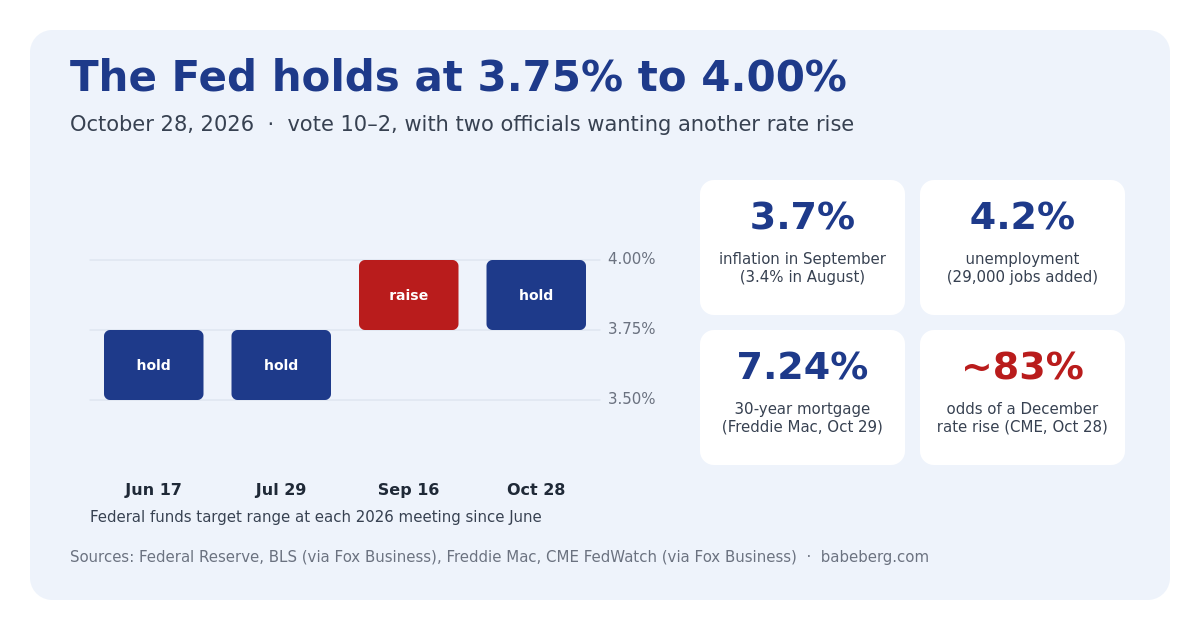
| June 17 | Hold | 3.50% – 3.75% | Unanimous |
| July 29 | Hold | 3.50% – 3.75% | 9–3 (three wanted a hike) |
| September 16 | Raise 0.25 point | 3.75% – 4.00% | 12–0 |
| October 28 | Hold | 3.75% – 4.00% | 10–2 (two wanted a hike) |
The direction of the argument inside the Fed is clear: since July, every dissent has been in favour of higher rates. The debate is about how fast to tighten, not whether to ease.
The numbers behind the decision
| Indicator | Latest | What it says |
|---|---|---|
| Consumer inflation, September | 3.7% a year (up from 3.4% in August) | Moving the wrong way, led by gasoline, diesel and crude oil |
| Jobs added, September | 29,000 (about 90,000 expected) | Hiring has slowed sharply |
| Unemployment rate | 4.2% (from 4.1%) | Still low, but edging up |
| Average hourly pay | +3.0% a year | Rising more slowly than prices |
| 30-year mortgage (Freddie Mac, Oct 29) | 7.24% (6.17% a year ago) | Expensive, though down from 7.40% in mid-October |
That table is the whole tension in one place. Inflation is rising, which argues for higher rates. But hiring slowed to almost nothing in September, which argues for caution: raise rates into a cooling job market and the Fed risks doing more damage than it intends. Holding buys time to see which way the October data point.
What it means for you
Borrowers. Credit card and home-equity rates follow the Fed's rate within days, so nothing changes this month. September's increase is still working its way through. If the Fed raises again in December, expect card and HELOC rates to follow within a statement cycle.
Home buyers and sellers. Mortgage rates aren't set by the Fed; they follow long-term bond yields. The 30-year average at 7.24% is about a full point higher than a year ago, and the gap between that and the rates of around 3% many owners locked in years ago keeps them from selling. Expect housing to stay slow and prices sticky while rates sit above 7%.
Savers. The good news is on this side. Savings accounts, CDs and money-market funds kept the bump from September's increase, and a December rise would push yields a little higher again.
Workers. Twenty-nine thousand jobs in a month is a warning light, not an emergency, with unemployment at 4.2%. But pay rising 3% while prices rise 3.7% means most households are falling behind in real terms, which is why the cost of living sits at the centre of the midterm campaign.
Investors. Markets took the hold calmly. Stocks rose slightly in the final hour of trading (S&P 500 +0.26%, Dow +0.28%, Nasdaq +0.17%), because a pause was expected and the statement didn't rule anything out.
Taxpayers. Higher rates also raise what the government pays to borrow. With the national debt above $40 trillion, each new Treasury auction at today's rates adds to the interest bill that comes out of every future budget.
What happens next
The next meeting is December 8–9. On the day of the decision, CME FedWatch put the odds of a quarter-point rise in December at 82.6%, up from 78.3% the day before, with a 16.9% chance of another hold. Kay Haigh of Goldman Sachs Asset Management expects the Fed to "resume rate hikes in December"; Seema Shah of Principal Asset Management argues the "Fed has time on its side" and can wait for more data.
Three things will decide it:
- October's inflation report. If energy prices keep pushing the headline number up, a December rise is likely.
- October's jobs report. Another month near September's 29,000 would make the Fed more cautious about adding pressure.
- Oil. Warsh noted that oil futures had "moved up over the course of the last several weeks." Energy is the main reason inflation turned up.
Warsh also announced a change to the calendar: from 2027 the Fed will hold seven rate-setting meetings a year instead of eight, with one meeting given over to strategy and no vote, and two such meetings in 2028. He said fewer decisions would improve their "quality."
For now, the message from October is the one the statement ends on. The Fed paused, it is watching the data, and its next move, if there is one, is more likely up than down.
Sources: Federal Reserve FOMC statement, October 28, 2026 · Federal Reserve FOMC statement, September 16, 2026 · Fox Business: October FOMC decision · NBC News: Fed leaves rates unchanged despite rising inflation · Fox Business: September jobs report · Freddie Mac: Mortgage rates decline further to 7.24% · Honolulu Star-Advertiser (Reuters): July hold with three dissents
0 Comments
No comments yet. Be the first!
Leave a Comment